
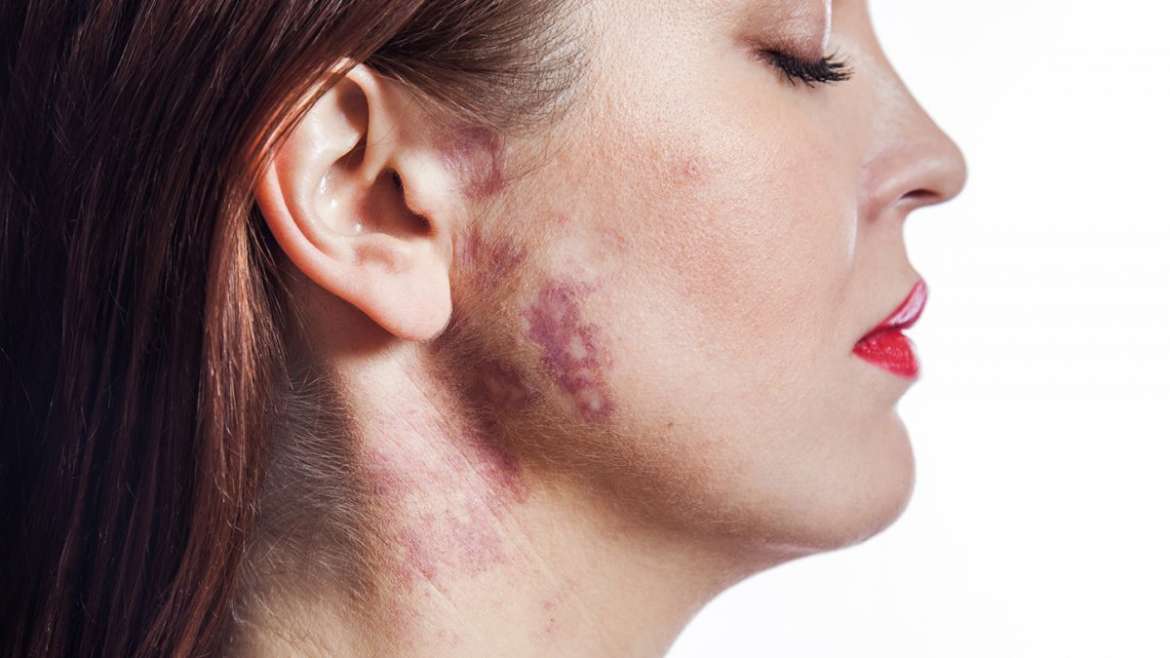
Port-wine stains or firemarks are observed as sharply defined flat patches on the skin, ranging in colour from red to purple, and they accompany an individual from birth.
well-being, and, in some cases, even on physical health of a person. Therefore, it is important to seek treatment for them. At Derma Center Rogaška, we treat fire marks using PDL laser therapy as part of a comprehensive patient care approach. We recommend early treatment, ideally starting in early childhood, as the skin is more receptive to treatment at that stage.
What is a port-wine stain?
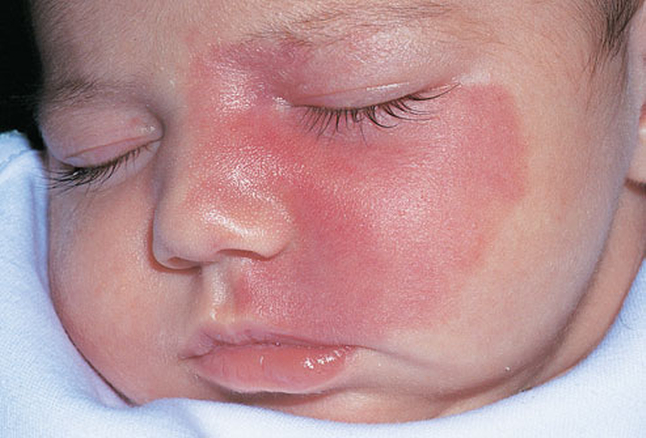
A port-wine stain or firemark (lat. Nevus flammeus) is a benign congenital malformation of the capillaries in the skin, which appears as a sharply circumscribed patch of red to purple colour. It occurs in 0.3 % of newborns, mainly on the face and neck, but may also occur elsewhere on the body. It rarely disappears without vascular laser treatment. The vast majority of firemarks worsen with age, becoming more intense in colour and thickening into so-called hypertrophic lesions, which are very difficult to treat. Thickening of firemarks is fairly common, with a median age of onset of 32 years. Above the age of 50 years, 70 % of the lesions have thickened[1].
The natural progression of port-wine stains and associated complications
Untreated port-wine stains thicken over the years and can cause health problems. If they are located around the eyes or mouth, they can affect their function, leading to bleeding and an increasingly unpleasant appearance. Fire marks on the eyelids can be associated with the appearance of glaucoma. If they are present on the face or other visible parts of the body, they cause emotional distress and disruption in the social life of the affected persons.
PDL laser treatment of port-mark stain
The PDL laser (595 nm) is a type of vascular laser that has the most evidence of effect on birthmarks and the fewest side effects. These characteristics make this vascular laser the first choice for the treatment of birthmarks.
The mechanism of action of the PDL laser is based on the principle of selective absorption of the laser light in the vascular structures, causing them to overheat, collapse and excrete the breakdown products from the body through the lymphatic channels and the natural exfoliation of the skin.
The effect of the PDL laser depends on five characteristics of patients with fire marks.
- Age – younger patients have a better chance of a good effect than older ones. The skin of newborns and younger children is thinner, has less of the skin pigment melanin and less collagen in the dermis. All of this allows for a greater effect of the laser light, more absorption in the capillaries and better heating of the capillary walls. It has the best effect in infants ≤ 6 months of age who have a fire mark on the face.
Early treatment has a better effect:
– 50 % improvement – onset < 2 years : 46 %
– 50 % improvement – onset < 6 years : 24 %
– 50 % improvement – onset > 6 years : 21 %
- Location of the firemark
The best effect is on the face, on the shadowed area of the forehead, less on the cheeks and the least on the jaw area. The face fades better than the neck and body. The worst effect is observed on the fingers or toes. The effect is related to the thickness of the skin on these areas.
- Size of the firemark
Smaller capillary marks fade better than larger ones.
- Thickness of the firemark
In two-thirds of cases, an untreated firemark becomes thicker, which occurs after the age of 32. Thinner birthmarks fade better than thicker ones. This is due to the poor penetration of the PDL laser light into the depth.
- Number of repeated PDL laser treatments
A better effect is achieved with more repetitions of the treatment. Patients who had a higher number of repetitions achieved a greater fading of the firemark.
Final effect of PDL laser therapy and limitations
The best evidence of efficacy in the treatment of firemarks comes from the use of the PDL laser: 43 % of patients achieve >75 % fading of their birthmarks [2].
A lower effect of treatment of firemarks is expected with [2]:
- In case of combined vascular malformation (e.g. veno-capillary) or arteriovenous malformation.
- The appearance of a focal nevus in the acral region – palms, feet, toes and fingers.
- Dark skin phototype (phototype IV or higher) – hypopigmentation of the skin may occur after the procedure!
- Higher age at the start of treatment – treatment is less effective in adults.
Dermoscopy helps to assess the success of treatment
Firemarks vary in how deep the veins are and their size and number, which is impossible to predict. A clue can be obtained by examining the firemark with a dermatoscope, which shows a globular pattern of blood vessels, typical of the easier-to-remove, superficial capillaries, and a linear pattern for the harder-to-remove, deeper capillaries.
Age of initiation of therapy
When to start?
The earlier the better. Effects in young children are much better than in older children and adults. [3], [4]
Current professional controversies on the management of anaesthesia in young children
In December 2016, the FDA (US Food and Drug Administration) issued a recommendation that anaesthesia should be avoided in children under 3 years of age, except in emergencies and when there is a risk of deterioration of the medical condition. [5]
A single anaesthetic is safe, but in the case of fire signs, at least 10 repetitions of PDL laser therapy should be performed, preferably at intervals of several weeks, to achieve a good effect.
In recent years, there have been published clinical studies in which PDL laser therapy for birthmarks has been performed in infants and young children without anaesthesia. [6]
The latter is considered controversial in some professional circles, as we do not yet have definitive evidence that repeated painful therapy in infants and young children does not have a negative impact on their neuropsychiatric development.
Neonatal pain or early stress can affect children’s development (especially in preterm infants and those less than 2 months old). Children exposed to pain early in life have been found to have a lower tolerance to pain later in life (from vaccination studies) [7], [8].
POSITION ON THE PERFORMANCE OF PDL LASER THERAPY IN NEONATES AND YOUNG CHILDREN WITHOUT AND WITH ANAESTHESIA
Untreated fire marks can have a significantly negative impact on the emotions and mental health of the individual, and in some cases on health, and should be treated. Performing PDL laser without anaesthesia in newborns and young children has fewer serious consequences compared to repeated anaesthesia, and is therefore recommended as follows:
PDL laser therapy and type of anaesthesia according to age:
> 1 month to 1.5 years, local anaesthesia or no local anaesthesia,
> 1.5 years to 10 years, procedure under general anaesthesia under the supervision of an anaesthetist (performed at the Rogaška Derma Center),
> 8 to 10 years, local anaesthesia is sufficient if they are motivated for the procedure.
The procedure is repeated every 6 weeks to 3 months.
In the first year of life, 5-6 treatments are performed without anaesthesia, or 1-3 treatments with general anaesthesia per year for age > 1.5 years.
The aim of PDL laser treatment of firemarks is to reduce their colour and size as much as possible by the time they enter school, which reduces the psychological pressure of entering a period of life where there is intense social contact outside the family.
What is the expected effect of PDL laser therapy?
It is best in young children and babies, with 65 % of them having very good improvement (75-99 % fading), with moderate improvement in 20 % of the cases and with10 % of the patients seeing little or no improvement.
How many treatments are needed?
The latter is difficult to predict, an estimate can be made after 2-4 PDL laser treatments. Usually, a total of 10-15 repetitions of the therapy should be done. During the first 5 to 6 treatments, the firemark improves rapidly, then fades and diminishes from one treatment to the next. Port-wine stains of a violet colour fade less effectively compared to those where red colour predominates.
How to assess the effect?
There are no standardized methods available to reliably and consistently compare the effectiveness of treatment for firemarks with vascular lasers. It is best to take a photograph with the same camera, taken under the same lighting conditions. Taking a photograph helps to assess the progress or stagnation of the treatment effect.
When to stop therapy?
The latter is always a difficult decision, as the response of firemarks to PDL laser therapy and other vascular lasers is very different. It is not possible to assess the response to the procedure earlier than after 3 treatments. Changing the parameters of the device, the way it is performed, increasing the energy of the light current used, etc., helps to improve the effect. Discontinuation of the therapy is a joint decision to be taken in agreement with the patient, parents and doctor.
From 5-7 days.
After 7 days.
Darkening of the firemarks may occur, so occasional repeat treatments are necessary. Darkening occurs to a lesser extent than before the procedure.
- Scarring (very rare);
- peeling of the skin (in dark phototypes;
- transient hypo- and hyperpigmentation of the skin;
- in newborns and younger children, long-lasting hair loss in the area of PDL laser treatment (eyebrows, hair) may occur in 1.5 %-2.6 % [9].
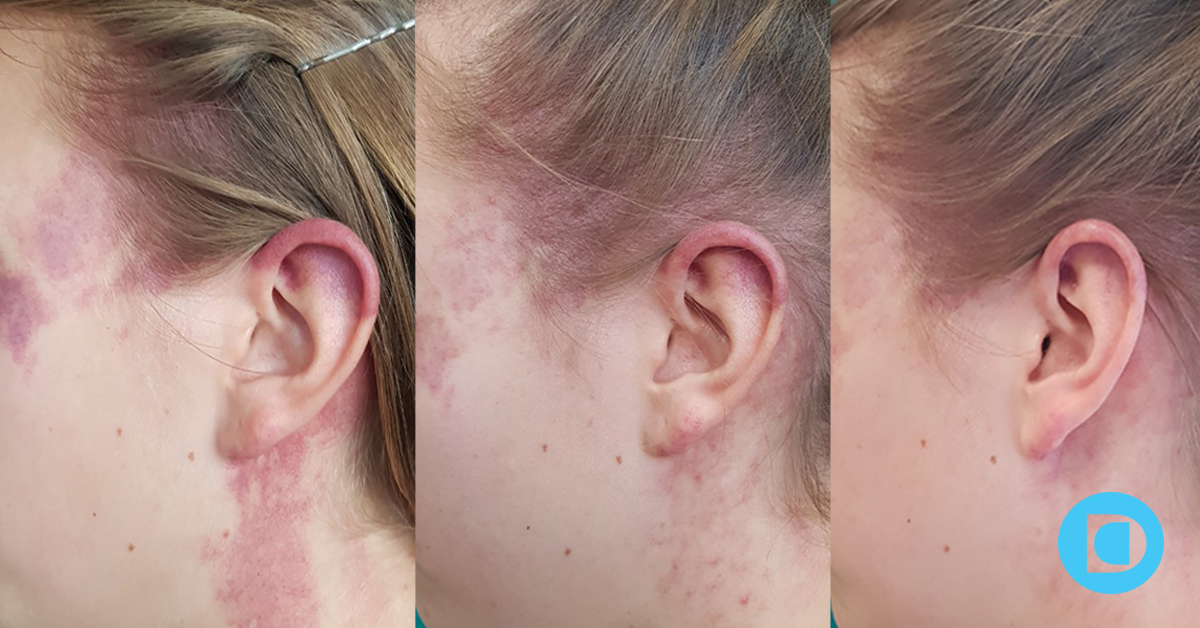
Photo gallery
Appointments and further information
To book an appointment, contact us Monday to Friday from 8:00 to 16:00 on the following telephone number: 064 12 80 15 or send an e-mail: info@derma-rogaska.si
SOURCES:
[1] Hypertrophy in port-wine stains: prevalence and patients characteristics in large patient cohort.Van Drooge ALL, Beek JF. J Am Acad Dermatol.2012 Dec;67(6):1214-9.doi: 10.1016/j.jaad.2012.05.027. Epub 2012 Jun 28.
[2] Sistematični pregled in meta-analiza 51 študij, 3068 pacientov. (Therapeutic Strategies for Untreated Capillary Malformations of the Head and Neck Region: A Systematic Rewiev and Meta-Analyses. Cinkaraa G, Langbroek GB, Am J dermatol 2021 Sep; 22(5): 603-614.)
[3] Ashinoff R. Flashlamp-pumped pulsed dye laser for port-wine stainsin infany: earlier versuslater treatment.J Acad Dermatol 1991; 24:467-472
[4] Namba Y, Mae O, Ao M. The treatment of port wine stains with a dye laser: a study of 644 patients. Scand J Plast Reconstr Surg Hand Surg. 2001. 35:197–202.
[5] Avoiding General Anesthesia in Treating Port- Wine Stains in infants to Avoid Neurotoxic Events- Reply. JAMA Dermatol. 2019Jul 3. Doi: 10.1001/jamadermatol.2019.1133
[6] Jeon H, Bernstein L; ulsed Dye Laser Treatment of Port-Wine Stains in Infancy Without the Need for General Anesthesia; JAMA Dermatol. 2019 Apr 1;155(4):504.
[7] Taddio et al. Effect of neonatal circumcision on pain response duringsubsequent routine vaccination.Lancet.1997 Mar 1;349(9052):599-603.doi: 10.1016/S0140-6736(96)10316-0.
[8] Hatfield LA. Neonatal pain: What`s age got to do with it. Surg Neurol Int. 2014; 5(Suppl 13): S479–S489.Published online 2014 Nov 13. doi: 10.4103/2152-7806.144630
[9] Feldstein S. Can long-term alopecia occur after appropriate pulsed-dye laser therapy in hair-bearing sites? Pediatric dermatologists weigh in. Dermatol Surg, 2015; 41(3): 348-51.