
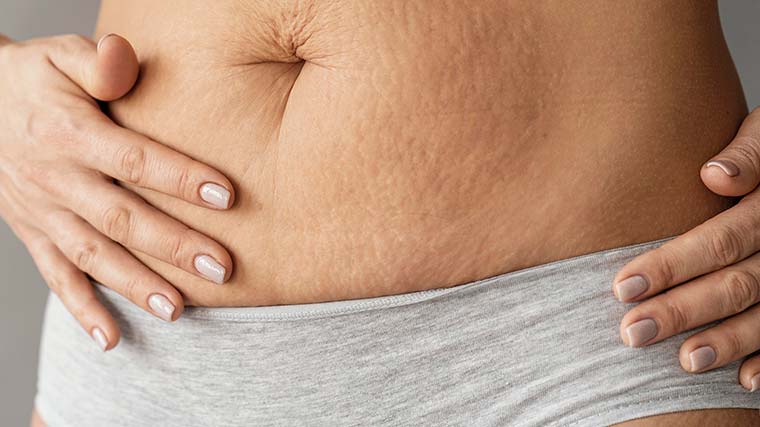
Stretch marks are formed on skin that is subjected to repeated and increased stretching. The exact cause of their formation is unknown although it seems that the stretching of the skin is caused by the release of enzymes from the skin cells, mast cells.
Mast cells (mastocytes) gradually damage the basic building blocks of the skin that are responsible for its elasticity – collagen and elastin. The skin breaks down in the area of greatest traction, the dermis, while the overlying epidermis remains unaffected. Stretch marks are initially red (Striae rubre – red stretch marks), but after several months they lose this colour and become mature (Striae albae – white stretch marks). They can occur anywhere, but are more common on parts of the body where there is more fatty tissue in the subcutaneous tissue: the abdomen and breasts in pregnant women, especially those who are overweight before and during pregnancy, the back in body builders, and in adolescents with poor posture and rapid growth. In overweight people, stretch marks also appear on the arms, but can also appear on the buttocks, hips, groin and underarms.
Risk factors for stretch marks
The most extensive stretch marks are caused by hormones – corticosteroids – that inhibit the production of collagen and elastin. Excessive and prolonged elevated concentrations of these hormones in the body may be the result of a rare adrenal disease, or more commonly, of the long-term intake of these hormones into the body as a result of treatment for many internal and dermatological diseases. The prevention of stretch marks through the use of creams, massage and similar procedures is not scientifically supported by reliable evidence of effectiveness. Dermatologists therefore advise maintaining a normal body weight, especially in pregnant women, correct posture in adolescents and avoiding excessive pulling of the skin through exercises against extreme exertion (weight lifting).
Smoothing stretch marks
Unfortunately, it is not possible to remove stretch marks completely, but there are treatments in aesthetic dermatology that can limit their appearance. Localised therapy can bring some improvement in the depth of mature stretch marks with the use of tretinoin creams for several months, while red stretch marks turn white after several months with or without the use of any cream.
The process of red stretch marks turning white can be accelerated by:
- vascular lasers,
- Intense pulsed light or ELOS technology
For white stretch marks, individual or a combination of treatments can be used to blur the boundary between the stretch mark edges and the surrounding skin, bring the stretch mark edges closer together and reduce the depth of the stretch marks.
- The least invasive procedures are the so-called non-ablative procedures, which use long-pulsed laser energy, radiofrequency or ELOS™ technology to stimulate skin cells to produce new collagen and elastin. The advantage of these procedures is the absence of healing of the skin surface, the disadvantage is their effectiveness, and they are therefore only suitable for less deep and less wide stretch marks.
- In ablative procedures, the skin is damaged in a controlled way, triggering a healing process that produces new collagen and elastin. Skin healing is more extensive in chemo abrasion, where first a few layers of the epidermis are mechanically abraded, followed by the application of an acid, which, after pre-treatment of the skin, penetrates the base of the stretch mark and not so much into the surrounding area. This results in more collagen being formed at the base of the stretch mark, which, after several iterations, evens out this skin defect with the surrounding skin. Fractional photothermolysis is the process of using lasers in the form of spatially correctly dispersed beams of laser light. In the case of ablative lasers, CO2 or Er:YAG, only a fraction of the scar or stretch mark can be removed with each pass of the laser head. This causes a number of microscopic lesions in the skin, in the form of a network of evenly spaced pinholes, which heal quickly by forming new collagen and other skin building blocks. The CO2 laser also has a pronounced effect on restoring tension to sagging skin. Sublative smoothing of stretch marks and scars and wrinkles with fractional radiofrequency – SUB-2 – has a similar effect. The advantage over chemo abrasion and ablative laser is the shorter healing time. However, if the skin is markedly sagging and the stretch marks are located on the abdomen, they can also be made less noticeable by a surgical procedure, skin stretching – abdominoplasty, but this will leave a scar on the lower abdomen.
- SkinPen microneedling is a method that uses rapid puncturing of the skin
its thin needles stimulate healing and collagen and elastin production. The depth of the stretch marks is reduced, the white colour is repigmented and the edges of the stretch marks become less sharp. The number of repetitions depends on the width of the stretch marks, for a 50% improvement in the appearance of the stretch marks, 3-6 repetitions should be done within a month.
- Fractora and Morpheus8 are two newer procedures that work on stretch marks in a similar way to microneedling, but in addition, the deeper layers of the skin are heated with a radiofrequency current using thin needles. The effect is in intensively stimulating the formation of the skin’s connective tissue (collagen and elastin), which reduces the visibility of stretch marks.
- NeoGen plasma works by intensely heating the entire surface of the skin with ionic plasma. This targets the top layer of the dermis, where the fibroblasts are located. These cells help the skin to renew itself by producing collagen, elastin and hyaluronic acid. The depth of the stretch marks is reduced and the edges become less visible.
- Radiesse is a dermal filler made from calcium hydroxyapatite, a component of bone. When injected into the skin, it gradually breaks down, stimulating fibroblasts to produce collagen. It is used for wide and deep stretch marks, where it has the effect of reducing their depth and the noticeable difference in colour with the surrounding skin.
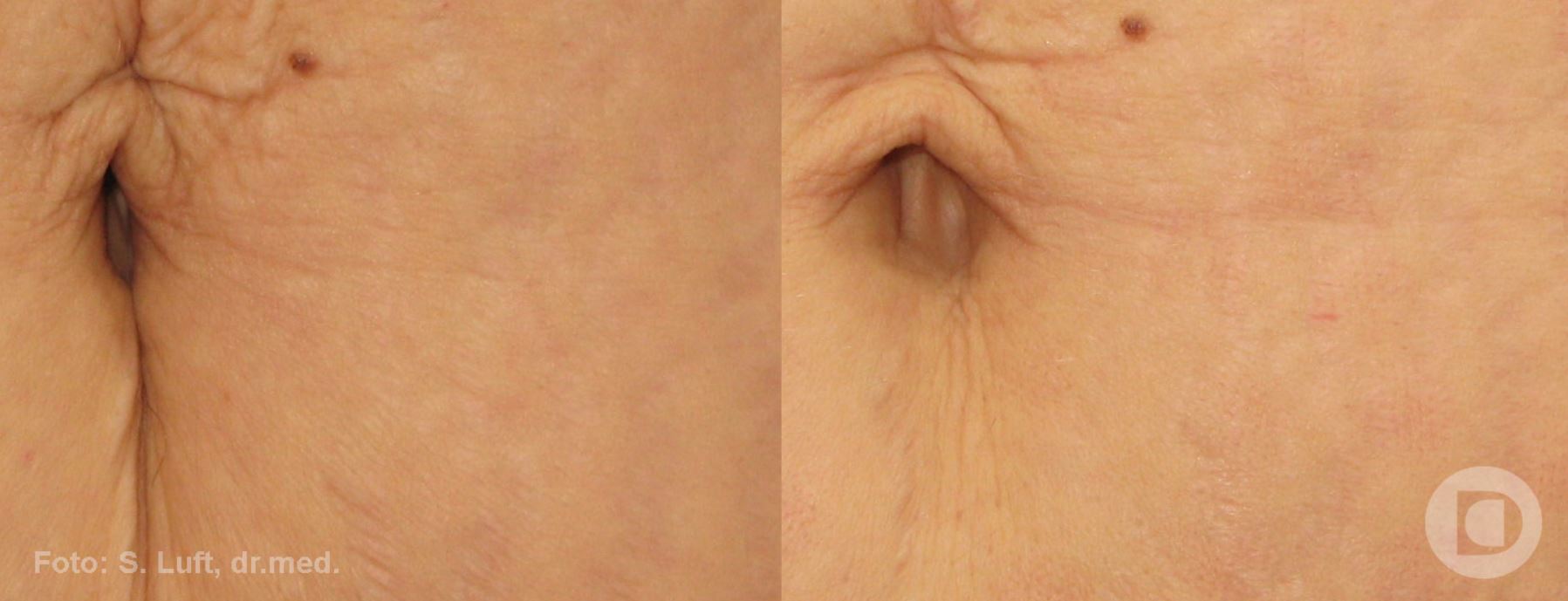
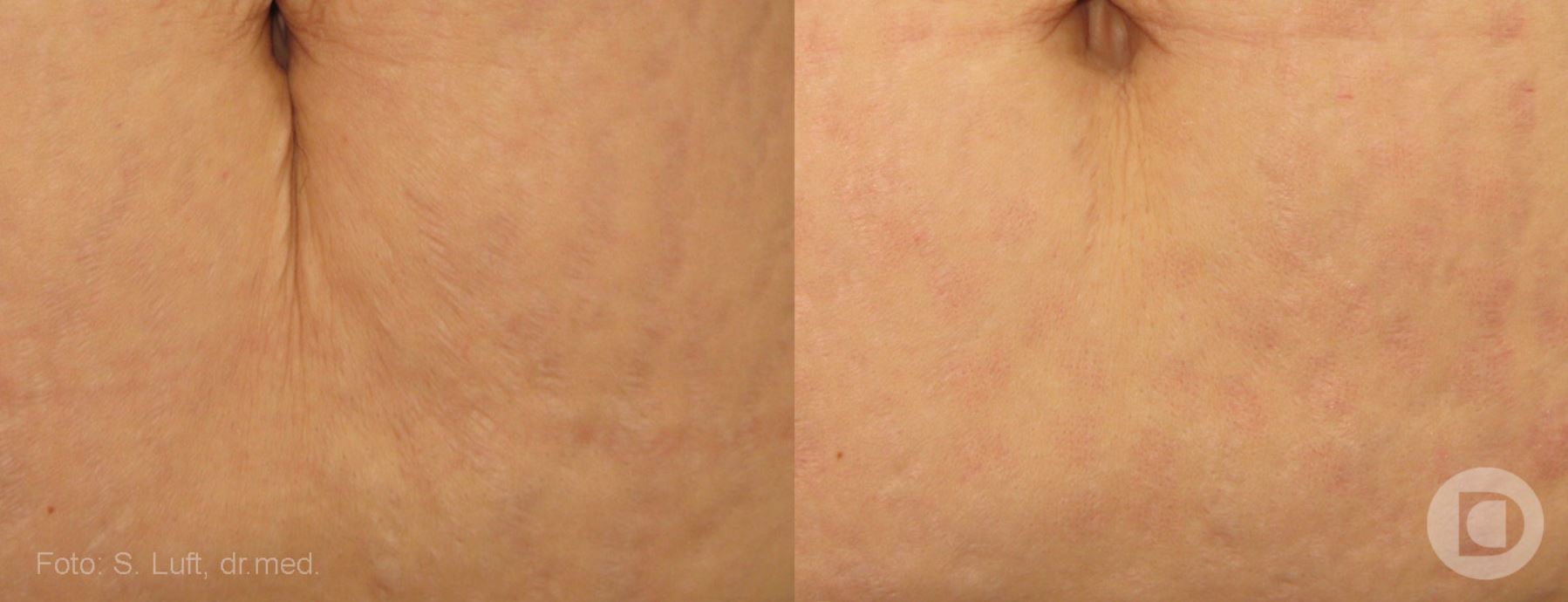
GALLERY
Appointments and further information
To book an appointment, contact us Monday to Friday from 8:00 to 16:00 on the following telephone number: 064 12 80 15 or send an e-mail: info@derma-rogaska.si