
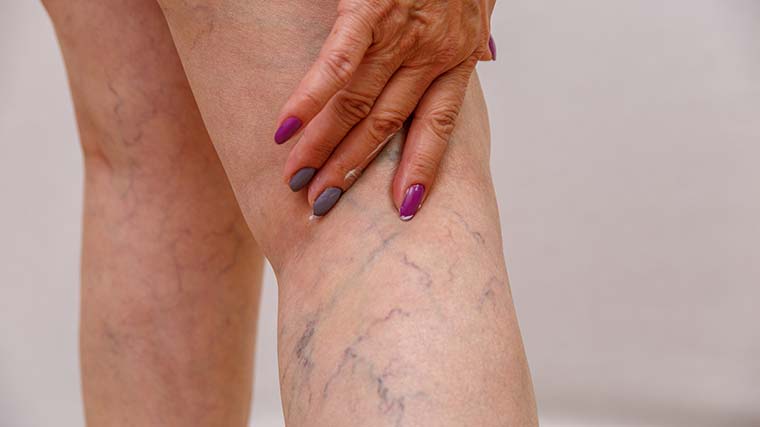
Veins are the blood vessels that return blood from the organs and limbs to the heart. If there is a prolonged and recurrent blockage in the blood flow from the lower limbs, symptoms and signs of CVD (chronic venous disease) occur.
In addition to varicose veins, which are blue in colour, there are blue-red coloured spider-shaped varicose veins and red capillaries as well as other signs on the skin.
Varicose veins are dilated, tortuous veins that may bulge above the surface of the skin. They are blue to bluish-purple in colour, several millimetres in diameter. Capillaries are millimetre-wide veins of red colour. In most cases, both types of veins are seen at the same time, which is very disturbing for many people. Often, troublesome capillaries and small varicose veins can be an aesthetic nuisance that does not cause serious symptoms. The appearance of capillaries is also influenced by photo-radiation, hormonal influences and previous injuries.
Treatment can reduce the symptoms of venous disease, such as pain, night cramps and heavy legs, and prevent the progression of this chronic disease. Capillaries and veins cannot be removed by soft measures or creams offered online, in drugstores or pharmacies. They can be removed by medical procedures, where a controlled injury is carried out to the wall of the varicose veins and capillaries, which are then gradually broken down and removed from the venous circulation.
Aesthetically disturbing veins and small varicose veins that are not related to advanced KBV are removed at the Derma Center Rogaška/Maribor by sclerotherapy or with vascular lasers.
When dilated veins are suspected to be due to CVD, it is necessary to perform an ultrasound of the superficial and deep venous system and to treat the damaged veins with a vascular surgeon or a dermatologist who is involved in the treatment of advanced chronic venous disease by sclerosant foam under ultrasound guidance, intravascular interventions with lasers, radiofrequency probes, special glue or microwaves. In these procedures, the damaged veins are removed from the circulation.
Sclerotherapy of varicose veins
Used to remove small varicose veins and varicoceles. The procedure is most effective in cases where the KBV is not in an advanced stage.
The process works as follows:
- The procedure is carried out in a lying position and the skin is disinfected with an antiseptic.
- A fine needle is used to inject a sclerosant solution into the vein, causing inflammation of the vein wall.
- The injection is made in several places and the puncture site is immediately covered with a patch.
- No anaesthesia is needed as you only feel a slight prick from the needle during the procedure.
- Sclerotherapy causes the walls of the varicose veins to stick together so that blood can no longer flow through them. This improves the circulation of venous blood in the legs and reduces swelling, symptoms and improves the appearance of the legs.
- The capillaries fade in 3-6 weeks, and the varicose veins gradually break down over 3-4 months.
- The best effect is achieved after 2 to 3 repetitions of the treatment.
- No absence from work is required.
Similarly to effects of vascular lasers, veins effectively removed by sclerotherapy disappear permanently, but new veins may appear over time due to the causes listed above for CBV.
The vascular laser is used to remove capillaries on the face, neck, chest, torso, legs and varicose veins up to 5 millimetres in diameter on the face and legs. The light from vascular lasers has the ability to be selectively absorbed by the blood pigment, haemoglobin. The vascular laser causes the walls of the capillaries and smaller veins to overheat, leaving the surrounding skin unharmed. The light from the lasers is concentrated in the targeted capillary, and the modified capillary is then broken down and removed from the skin through the blood vessels.
The procedure works as follows:
- Before the procedure, the skin must be cleansed of creams, make-up, perfumes, spritzers, oil-based shower gels. Hair must be trimmed, preferably shaved.
- Before the procedure, clean the skin with antiseptic fluid and protect the eyes with protective goggles.
- The laser head is positioned exactly over the vein to be removed.
- The skin is cooled with cooling gel, cooling gas or a chilled spout. Nevertheless, a stinging sensation is felt, which is more pronounced in larger varicose veins and less pronounced in capillaries.
- During the procedure, the walls of the veins are shrunk, and the varicose veins and capillaries treated with the vascular laser are eliminated from the venous circulation in the legs. Consequently, occasional pain in the veins disappears and the appearance of the legs improves.
- The capillaries may disappear immediately after the procedure or become opaque and not fade on pressure. They break down within a few weeks.
- Varicose veins that are blue or blue-red, up to 5 millimetres wide, shrink and turn a pale red colour after the procedure. They gradually break down and disintegrate over a few months.
- Capillary and varicose vein laser removal is only possible on non-suntanned skin.
- Wearing compression stockings after the laser procedure is mostly not necessary. You can use a regular moisturiser to take care of your skin.
- After the procedure, sun protection is advised until the redness of the skin has disappeared. Sunscreen helps to prevent the appearance of excessive pigmentation of the skin at the site of the procedure.
- Year-round sun protection prevents telangiectasias and skin cancer.
- For the full effect, more than three repetitions of the procedure are needed.
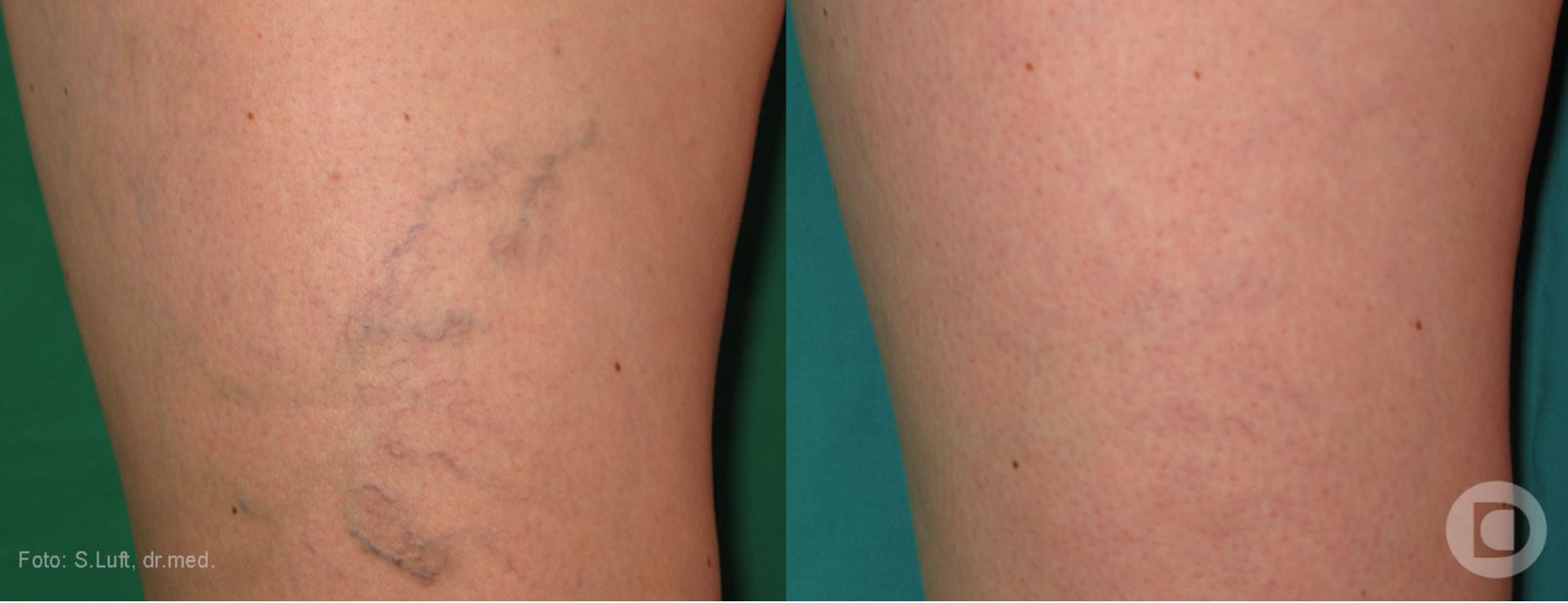
The degree of improvement depends on the number of repetitions of the procedure and the individual difference in the expression of varicose veins and capillaries between different individuals.
GALLERY
Appointments and further information
o book an appointment, contact us Monday to Friday from 8:00 to 16:00 on the following telephone number: 064 12 80 15 or send an e-mail: info@derma-rogaska.si