

A chemical peel is designed to improve the texture of the skin.
In this procedure, a selected acid solution is applied to the face to cause controlled damage to a specific layer of the skin, triggering complex processes of healing, remodelling and the production of new collagen as well as elastin. The result is a smooth skin, free of visible wrinkles, growths, scars, spots and acne.
Benefits
Only in the hands of an experienced practitioner can the described outpatient procedure be effective and safe, with minimal and transient complications, if any, in the vast majority of cases. Depending on the problem, the dermatologist will choose the most appropriate version of fruit or other acids, as some work better for a particular indication or skin type, or even do not cause visible peel. No medical follow-up is required, except for deep chemical peels, as this is a well-known procedure, supported by long-term experience and evidence. It can be combined with laser, mesotherapy, microdermabrasion, platelet-rich plasma, botulinum toxin and fillers.
Indications
Superficial chemical peel:
- enlarged pores,
- fine lines and wrinkles,
- an uneven skin tone,
- skin without shine.
Medium-depth chemical peel:
- enlarged pores,
- medium deep wrinkles,
- uneven pigmentation,
- sunspots, brown spots,
- thin seborrheic and actinic keratoses.
Deep chemical peel:
- advanced photo-aging of the skin and solar elastosis,
- yellowish skin,
- numerous instances of hyperpigmentation,
- numerous medium and deep wrinkles on the face,
- seborrheic and actinic keratoses.
Expectations
The intensity of the peel depends on the depth of the acid action. Thus, subtle, mild peel that can be masked by the use of moisturising creams will be the result of a superficial chemical peel. To achieve the best result, it should therefore be repeated at several consecutive intervals. However, you can expect more pronounced peel, which may be accompanied by transient redness or mild swelling for the first few days, with a medium-depth peel. It can be repeated every six to twelve months or two years, depending on the treatment or the changes you want to remove. After a deep chemical peel, special bandages are applied for 24 hours or longer and then a special powder is used for about a week. After a week, the skin is pink and after several months it gradually fades.
Recovery
Redness and irritation rarely occur after a superficial peel. Therefore, no special treatment is needed and you can return to work the day after the procedure. With a medium-depth peel, a new layer forms in three to seven days and within two weeks the skin is fully restored. We recommend staying at home for the first few days. With a deep peel, however, the new layer of skin does not start to appear until seven to ten days after the procedure, and it can take two months or more for the full recovery to take place. In any case, we advise you to take at least ten days off work to recover.
A chemical peel is a procedure that intervenes in the body and therefore falls within the field of medicine. It can be performed by a doctor who has a thorough knowledge of the chemical peel process and skin diseases, and therefore a better “feel(ing)” for selecting suitable candidates. One or more chemical solutions are applied to the pre-cleansed skin to cause limited and controlled damage to the skin, which stimulates the healing and repair process.
Most patients feel a slight to moderate burning pain that lasts for a few minutes. After the procedure, the skin calms down and the burning sensation does not return. Only with a deep chemical peel, it is necessary to use painkillers before and after the procedure on a large area of the face.
Depending on the solution used and the depth of its action, you may experience fine, a barely noticeable peeling with very superficial chemical peels and mild peeling with stronger superficial chemical peels. Such peeling is not an obstacle when interacting with people in the family or at work, as it can be hidden by the use of moisturisers. Superficial and very superficial chemical peels should be repeated at several consecutive intervals, as this is the only way to achieve the best result. More pronounced peeling is to be expected with medium-depth chemical peels, where there is also some transient redness of the skin and occasional mild swelling during the first few days. The peel may be repeated every 6-12 months or every two years, depending on the changes to be removed or the method of treatment. After a deep chemical peel, special bandages are applied for 24 hours or longer, after which a special powder is used for up to a week. During this period, all social contacts are impeded. After a week, the skin is pink and after several months it gradually fades.
After a superficial peel, the skin is rarely irritated, red and no special treatment or time away from daily life is needed.
After a medium-depth peel, a new layer of skin starts to appear in 3 to 7 days. After 14 days, the skin is fully restored. Patients usually stay at home for a few days.
After a deep peel, a new layer of skin starts to appear 7 to 10 days after the peel. It can take two months or more for the skin to fully recover. Patients usually take 10 days off work.
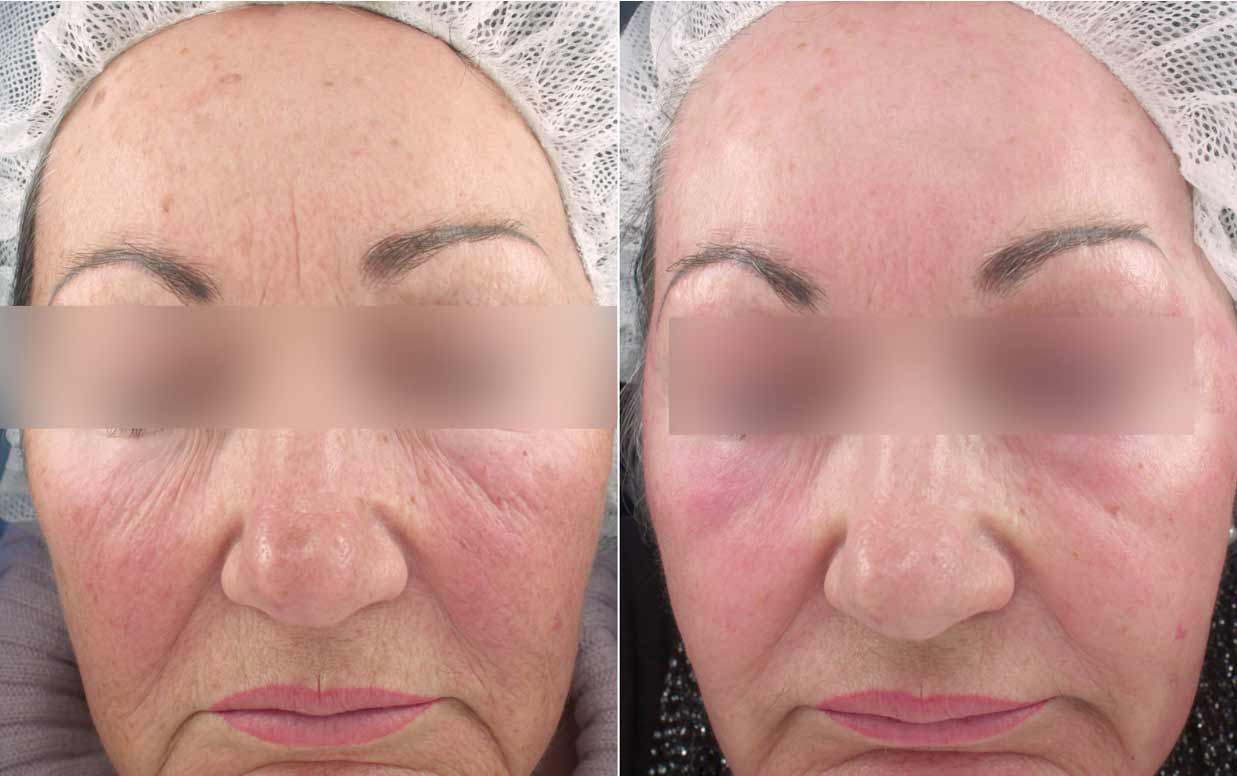
Photo gallery


Appointments and further information
To book an appointment, contact us Monday to Friday from 8:00 to 16:00 on the following telephone number: 064 12 80 15 or send an e-mail: info@derma-rogaska.si